

Let's skip the preamble.
Right now, patients in your city are asking ChatGPT, Perplexity, and Google Gemini to recommend a chiropractor. The AI is answering them — directly, confidently, with specific practice names.
Your name is either in that answer or it isn't.
Patients are asking ChatGPT, Perplexity, and Google Gemini to recommend healthcare providers. They're asking questions like:
- “What's the best chiropractic clinic for sciatica in [city]?”
- “Who should I see for neck pain after a car accident?”
- “What chiropractor near me specializes in sports injuries?”
These aren't searches. They're questions. And answer engines answer them directly — with a short list of recommendations.
This is Answer Engine Optimization (AEO). And if your practice isn't optimized for it, you're not just ranking low. You're not being mentioned at all.
What Is AEO, Exactly?
Answer Engine Optimization is the practice of structuring your content and online presence so that AI-powered answer engines — ChatGPT, Perplexity, Google's AI Overviews, Gemini, Grok — can understand who you are, what you treat, where you're located, and why you should be recommended.
It's different from traditional SEO in one fundamental way:
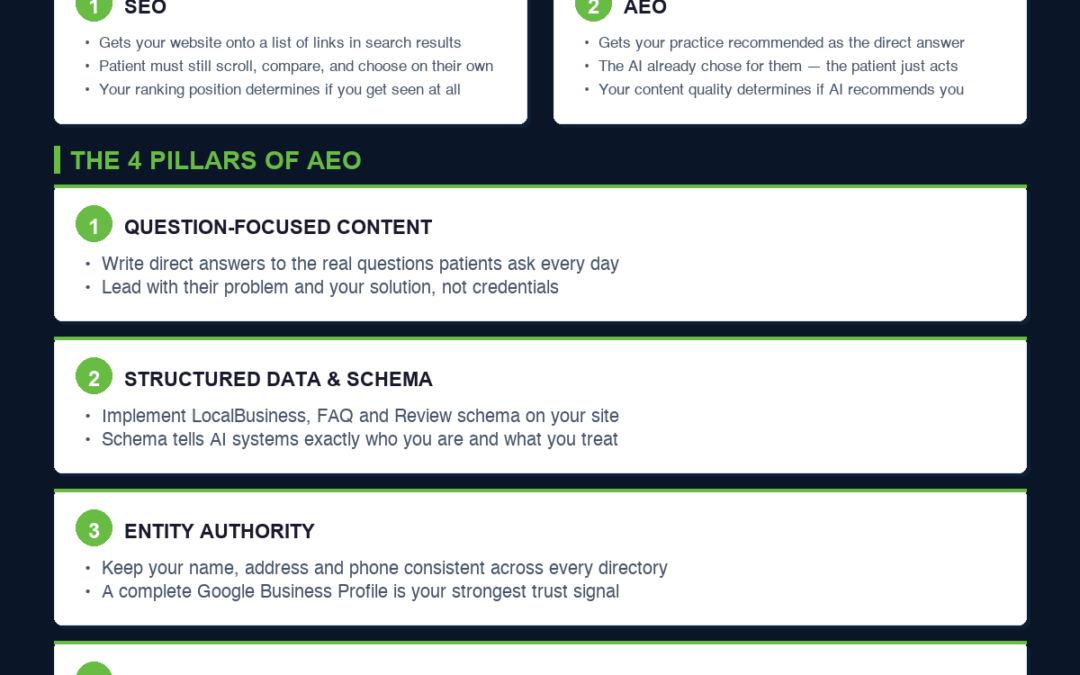
SEO gets you listed. AEO gets you recommended.
Traditional search gives users a list of links. They click, they compare, they decide. Your job is to get high enough on the list to get clicked.
Answer engines skip that step. They synthesize information and deliver a direct answer. “Here are two or three practices that match what you're looking for.” No list to scroll. No comparison browsing. Just a recommendation.
That's why AEO matters so much. The practices that AI engines recommend get the click, the call, and the appointment. Everyone else is invisible.
Why Chiropractors Are Uniquely Well-Positioned for AEO — If They Do It Right
Here's the underreported story: chiropractic is one of the most heavily searched healthcare specialties in the country. Millions of people search for chiropractic care every month. Back pain, neck pain, headaches, sports injuries, prenatal care — the conditions chiropractors treat are among the most common health complaints Americans experience.
That volume of search means answer engines are getting millions of chiropractic-related questions every month. And they're answering them — with or without your help.
The practices that win in AEO are the ones that give AI systems the clearest, most credible, most structured information to work with. The practices that lose are the ones with generic websites, inconsistent directory listings, and content that doesn't clearly answer patient questions.
Which category is your practice in?
The Four Pillars of AEO for Chiropractic Practices
1. Question-Focused Content
Answer engines are built to answer questions. Your content should be built to answer questions too.
This means moving away from self-promotional content (“Dr. Smith has 20 years of experience”) and toward educational, question-answering content that addresses what your patients actually want to know.
Think about the questions your front desk gets every day:
- How long does a chiropractic adjustment take?
- Is chiropractic care covered by insurance?
- What should I expect on my first visit?
- Can a chiropractor help with [specific condition]?
Every one of those questions is a content opportunity. Write a clear, direct answer — not a sales pitch — and you become a resource that AI engines can pull from when patients ask similar questions.
2. Structured Data and Schema Markup
Structured data is the technical layer that helps AI systems understand your content faster and more accurately. For chiropractic practices, the most important schema types include:
- LocalBusiness schema — tells AI systems exactly who you are, where you are, and what you do
- MedicalBusiness schema — categorizes you properly within healthcare
- FAQ schema — presents your Q&A content in a format AI engines are built to read
- Review schema — surfaces your ratings and review count as credibility signals
Most chiropractic websites have none of this. Which means the practices that implement it gain an immediate, measurable edge.
3. Entity Authority
AI systems think in terms of entities — people, places, organizations, topics. Your practice is an entity. Your job is to make sure that entity is well-defined, consistently described, and widely cited across the web.
This means:
- Consistent name, address, and phone number across every directory listing
- A complete and active Google Business Profile
- Mentions in local publications, chiropractic associations, and healthcare directories
- A clear “About” page that tells AI systems exactly who you are and what you specialize in
The more consistently and widely your practice is described across the web, the stronger your entity authority — and the more likely AI systems are to recommend you.
4. Review Volume and Recency
Reviews are a credibility signal that AI engines weight heavily. Not just for quantity, but for recency and specificity.
A practice with 200 reviews that include specific mentions of conditions treated (“helped my sciatica,” “great for sports injuries,” “best for pregnancy chiropractic”) is giving AI systems exactly the kind of signal they need to match the practice to relevant queries.
If you're not actively building reviews, you're leaving AEO performance on the table.
The Patient Journey in an AEO World
Here's what the new patient acquisition journey looks like when AEO is working:
- A patient in your city experiences lower back pain.
- They open ChatGPT and ask: “Who's the best chiropractor for lower back pain near [city]?”
- ChatGPT pulls from its training data and real-time sources, evaluating credibility, reviews, content relevance, and entity clarity.
- It recommends two or three practices — and yours is one of them.
- The patient clicks your link, reads your site, and books an appointment.
Notice what didn't happen: they never saw a Google search results page. They never scrolled past your competitors. They got a recommendation, and they acted on it.
That's the AEO pipeline. And for practices that have built it, it's producing real patients — not impressions, not clicks — patients.
What Most Chiropractic Websites Get Wrong
Let's be honest about the state of most chiropractic websites.
They're written for the practice owner, not the patient. They lead with doctor credentials and office photos. They use vague language like “comprehensive chiropractic care” that doesn't tell anyone — human or AI — what specific problems you solve.
They have no structured data. Their directory listings are inconsistent. Their content hasn't been updated in years. Their FAQ page, if it exists, answers three questions that no patient has ever actually asked.
This is fixable. But it requires thinking about your website as a resource for patients and a data source for AI systems — not a digital brochure for your practice.
How ChiroCandy Approaches AEO
We've been in chiropractic marketing since 2015. We've seen every search algorithm change, every platform shift, every new tactic that either stuck or faded.
AEO is sticking. It's not a trend — it's a structural shift in how patients find healthcare providers.
Our AEO approach for chiropractic practices covers:
- Content strategy built around real patient questions and conditions
- Full technical implementation of structured data and schema markup
- Entity authority development across directories, associations, and citation sources
- Review strategy that drives volume, recency, and condition-specific mentions
- Ongoing monitoring of AI search visibility across ChatGPT, Perplexity, Gemini, and AI Overviews
We work with practices that want to lead in their market — not catch up to it.
If you want to know where your practice stands in answer engine results — and what it would take to be the one AI recommends — schedule a call with our team.
[Schedule a call with ChiroCandy →]
ChiroCandy has helped 2,000+ chiropractic offices grow through SEO, local search, paid media, and AI search strategies. Serving practices nationwide.
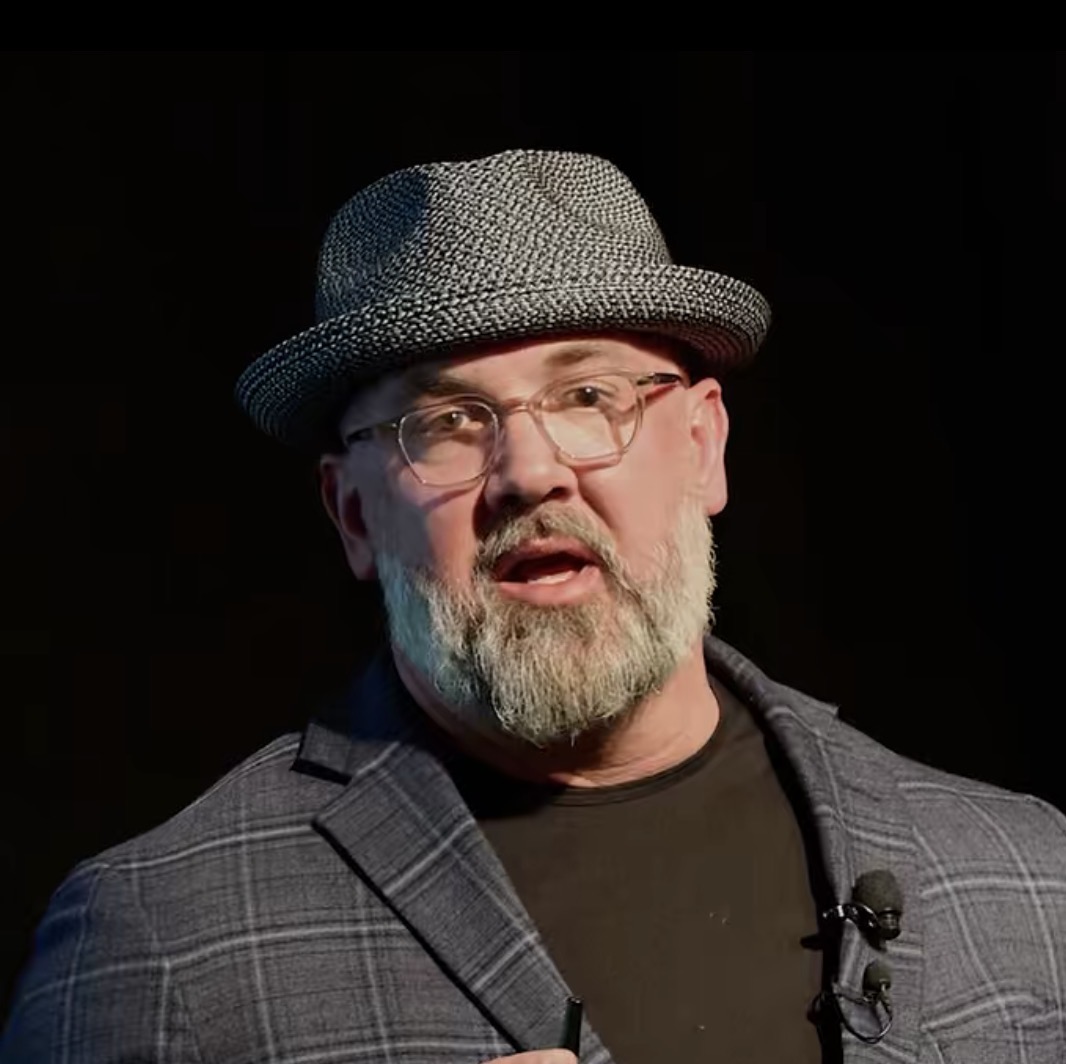
Billy Sticker is the founder of ChiroCandy and co-founder of HireZim.ai. Since 2015, he has helped more than 2,000 chiropractic and healthcare offices generate over $450 million in revenue through smarter marketing, stronger visibility, and practical growth systems.