
Here's something that should get your attention.
Right now, someone in your city is typing this into ChatGPT:
“Who is the best chiropractor near me for lower back pain?”
And ChatGPT is answering them. With names. With recommendations. With confidence.
The question is: is your name one of them?
If you've been focused on Google rankings and not thinking about AI search, you may already be losing new patients to competitors who figured this out first. And unlike a Google rank you can check in 30 seconds, most chiropractors have no idea where they stand in AI search results — which means most aren't doing anything about it.
That changes today.
The Search Landscape Just Changed. Again.
You lived through the shift from Yellow Pages to Google. You (hopefully) adapted.
Now there's another shift underway — and it's moving faster.
In September 2025, Google still handled 99.4 billion monthly searches. But ChatGPT pulled 5.6 billion monthly users that same month, up from near-zero just a few years ago. Perplexity, Google's AI Overviews, Gemini, and Microsoft Copilot are all growing.
Here's what makes this shift different from the last one:
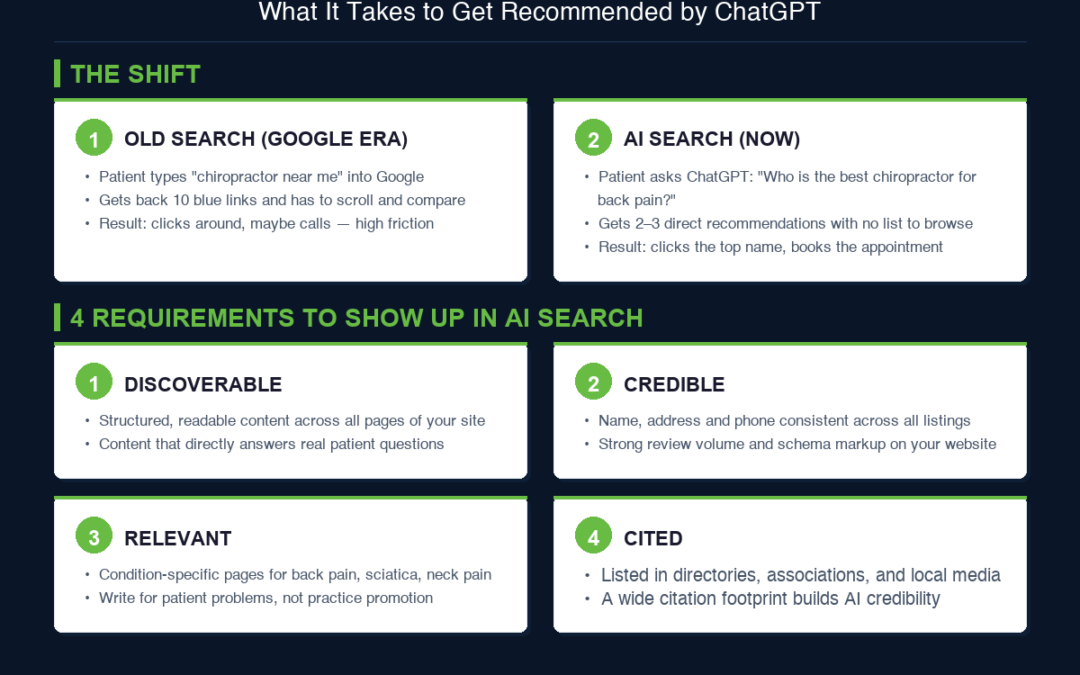
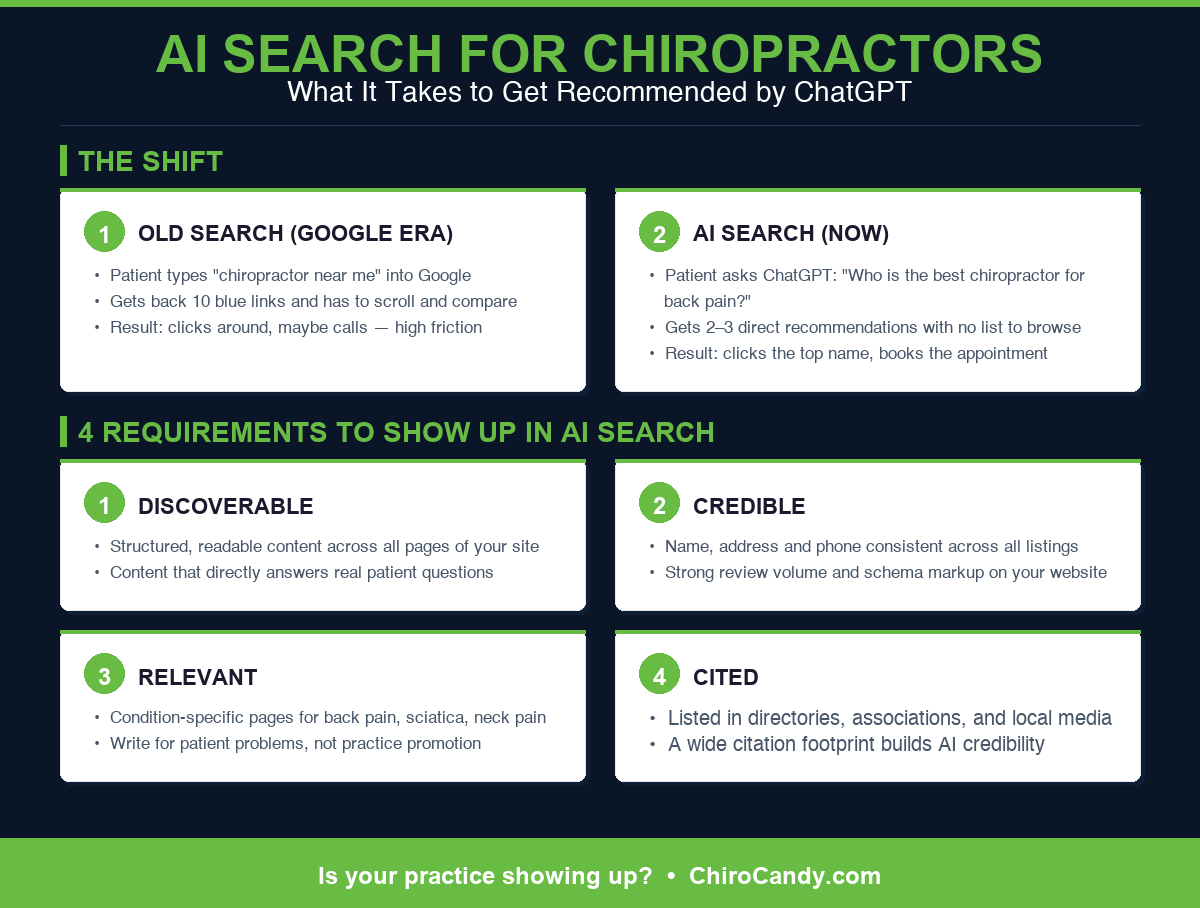
When someone Googles “chiropractor near me,” they get a list. A dozen options. They scroll. They compare. They click around. Your website gets a shot.
When someone asks ChatGPT “Who's the best chiropractor for neck pain in Houston?”, they get a short answer. Two or three names. Maybe yours. Maybe not.
That's a fundamentally different kind of competition. And most chiropractors aren't prepared for it.
Why AI Search Behaves Differently (And Why That Matters to You)
Traditional search engines index pages and rank them based on keywords, links, and authority signals. AI search platforms do something different — they synthesize information from across the web, evaluate credibility, and generate a direct answer.
To be recommended by an AI search engine, your practice has to be:
1. Discoverable — Your website, Google Business Profile, and online mentions need to exist in a form that AI systems can find and read. This isn't just about having a website. It's about having well-structured, clearly written content that answers the questions your patients actually ask.
2. Credible — AI systems prioritize sources they consider trustworthy. That means consistent NAP (name, address, phone) data across directories, strong reviews, structured schema markup, and authoritative content on your site.
3. Relevant — Your content needs to specifically address the problems patients search for. Generic pages about “chiropractic care” aren't enough. Pages that clearly address back pain, neck pain, sciatica, sports injuries, and other specific conditions give AI systems what they need to match you to relevant queries.
4. Cited elsewhere — AI systems don't just look at your website. They look at what the broader web says about you. Local news mentions, professional directory listings, podcast appearances, press releases — all of these create the citation footprint that signals to AI that your practice is a real, recognized authority.
If you're missing any of these, you're invisible in AI search. Not ranking low. Invisible.
The Practical Reality for Your Practice
Let's get specific about what this means for patient flow.
Healthcare searches are among the highest-volume categories in AI search. Patients use these tools because they want a trusted recommendation fast. They're not browsing. They're deciding.
When an AI engine recommends a chiropractor, most users act on that recommendation. They click. They call. They book. The conversion rate on AI-generated recommendations is higher than on traditional search results because the AI has already done the “research” for them — or at least, that's how they experience it.
This creates a real opportunity for practices that position themselves correctly.
It also creates a real risk for practices that don't. If your competitor down the street is showing up in AI recommendations and you're not, they're getting the call. Simple as that.
Five Things You Can Do Right Now to Show Up in AI Search
You don't have to overhaul your entire marketing strategy overnight. Start with these:
1. Audit your Google Business Profile.
AI systems pull heavily from Google's entity data. Make sure your GBP is complete, accurate, and regularly updated with posts, photos, and responses to reviews.
2. Write content that answers real questions.
Stop writing about your practice. Start writing about your patient's problems. “What causes lower back pain?” “Is chiropractic safe during pregnancy?” “How many visits does it take to see results?” These are the questions patients ask AI engines — and if your content answers them well, you become a source.
3. Add FAQ schema to your website.
Structured data markup helps AI systems understand what your content is about. FAQ schema is one of the most direct signals you can send that says, “this page answers questions.”
4. Get consistent across directories.
Check your NAP data on Google, Yelp, Healthgrades, ZocDoc, Bing Places, and other directories. Inconsistencies erode AI trust signals.
5. Build your review volume.
More reviews, more recency, more variety. AI systems treat review volume and quality as a credibility signal. This is not optional if you want to be recommended.
The Window Is Open — But It Won't Stay That Way
Right now, most chiropractors are either unaware of AI search or treating it as a future problem. That creates a window for practices that move now.
Early movers in any new search paradigm win disproportionately. They build authority while the competition is still figuring out what's happening. By the time everyone else catches up, they've established the citation footprint, the content depth, and the credibility signals that are hard to replicate quickly.
This is that moment for AI search.
The chiropractors who invest in AI search optimization in 2025 and 2026 will be the ones showing up in AI recommendations in 2027 and beyond — while their competitors are still wondering why their Google traffic is declining.
What ChiroCandy Does Differently
ChiroCandy has been marketing chiropractic practices since 2015. We've helped over 2,000 offices generate more than $450 million in patient revenue. We've navigated every search shift in that time — from local pack updates to mobile-first indexing to AI Overviews.
AI search isn't a side project for us. It's where we've been pointing every client strategy for the past year.
If you want to know exactly where your practice stands in AI search — what AI engines are saying about you, where the gaps are, and what needs to change — let's talk.
[Schedule a call with the ChiroCandy team →]
No pressure. No pitch deck. Just a clear picture of where you stand and what it would take to get ahead.
ChiroCandy has helped 2,000+ chiropractic practices grow through SEO, local search, paid media, and now AI search optimization. Based in the US, serving practices nationwide.

Billy Sticker is the founder of ChiroCandy and co-founder of HireZim.ai. Since 2015, he has helped more than 2,000 chiropractic and healthcare offices generate over $450 million in revenue through smarter marketing, stronger visibility, and practical growth systems.